Tuesday, April 29, 2025

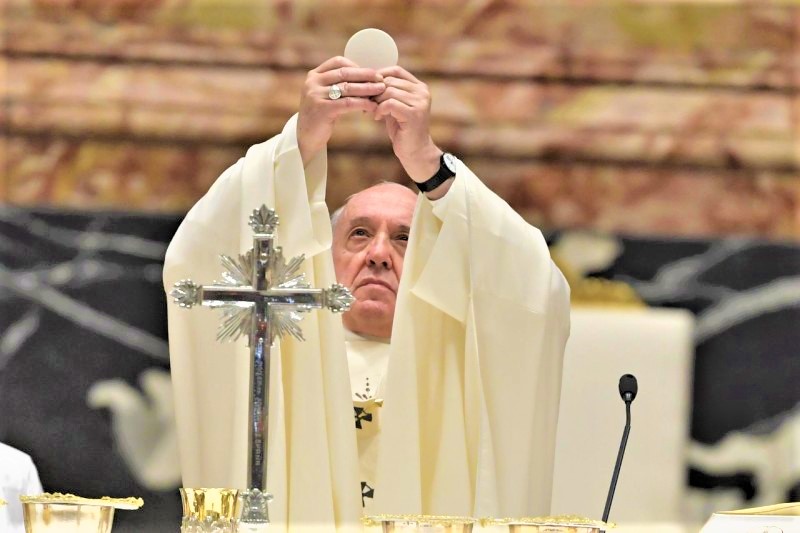
Pope Francis Memorial Mass

Yesterday, we had a Mass in Honor of Pope Francis. I would assume that the propers used were from the masses from the dead, from the prayers for the Pontiff. The color of the vestments for the mass was Red. We had one celebrating priest (no con-celebrants), and two deacons. One deacon wore the dalmatic, and the other wore only the stole. I was put in charge of incense, and for the first time, I followed the GIRM:

From the epiclesis until the Priest shows the chalice, the Deacon usually remains kneeling. If several Deacons are present, one of them may place incense in the thurible for the Consecration and incense the host and the chalice at the elevation.

Compare this to mass without a deacon:

 If incense is being used, when the host and the chalice are shown to the people after the Consecration, a minister incenses them.

 Normally we only have one deacon, so when I do incense usually, I kneel at the foot of the altar and incense as the priest elevates the host and chalice. But today, since we had two deacons, and we was willing to help, I was able to have the deacon incense the host and chalice. 

It was a nice service. I wanted to make two notes with this for your use. First, incense. How the deacon is the one to incense. As well, we wore red today. All the music was on the organ. Which the entrance was an antiphon. And the Presentation Hymn was "These Alone are Enough", which I also believe was written by Saint Ignatius of Loyola, which is nice, because he was the founder of the Jesuits, and Pope Francis was Jesuit. And the Communion hymn was also an antiphon, and both the antiphons were from the Funeral mass.


Orate Pro Papa Francisco, Requiscat in Pace +; Eternal Rest Grant unto Him O Lord, and Let Perpetual Light Shine Upom Him

Saturday, April 26, 2025

Sunday Mass & Masses for the Dead

Due to the passing of a Pope, we enter a period of mourning and a period of Sedevancantism. Following the passing of Pope Emeritus Benedict XVI, many of the changes that take place at the passing of a Pope did not take place. A period of Sedevancantism did follow the retirement of Pope Benedict XVI, but a period of mourning did not take place, at least not in tbe same way as Pope Francis. I do believe there was a period of mourning. Popes John Paul II and Francis both died during the Easter Octave. In some places, masses for the dead were allowed to be celebrated. Normally, masses for the dead are not allowed during the Octave days. Besides that, Pope Emeritus Benedict XVI died during the Christmas Octave. I believe there were masses celebrated for him following his passing. In most places, displays are set up for the deceased Pope, with his picture and a black cloth (Saint John Vianney Seminary had a picture with the Pope and a black stole over, that they posted on Instagram, and which I put here). Besides this, the name of the pope is removed during Sedevancantism, such as when Benedict retired. The name of the pope is completely skipped and in the Eucharistic prayer the name of the bishop is immediately said. Besides this, the name of the deceased pope may be added in the commemoration of the dead. And prayers during the petitions, or homily, or announcements, or following mass, may be said.

Requiscat in Pace, Papa Franciscus + Eternal Rest Grant Unto Him O Lord, and Let Perpetual Light Shine Upon Him;May his soul and all the souls of the faithful departed, through the mercy of God, rest in peace. Amen.

Friday, April 25, 2025

Holy Communion Outside of Mass - A Latin Edition

Some of you may know about a service called: "The Distribution of Communion Outside of Mass". You may have attended one of these services before. I have only ever attended one which was held by a deacon, in place of a normal daily mass. The USCCB recently released an updated version of the text in 2024. And I recently purchased the Catholic Book Publishing Co.'s release of it. 

But I was looking at the prefaces to it (that is the prefacing page s and introduction), and they have three letters in the beginning. And in there is the Latin title for the book (and it's a long one): De sacra communione et de cultu mysterii eucharistici extra missam. Which the English version is called: Holy Communion and the Worship of the Eucharistic Mystery Outside Mass. (Which covers the Distribution of Communion but also Adoration and Viaticum and Communion of the Sick).

Now if you look up De sacra communione et de cultu mysterii eucharistici extra missam, you will find a copy of it, that you can download and print as a PDF. This version comes from Archive.org (The Internet Archive), which is an amazing website, that is basically a digital library, with millions of archives of books, music, and other text and audio and software related things. Here is the Latin Version.

I am unaware of where you can find Latin versions of the book in print. If you want, you can always download the PDF and print it out and bind it, or whatever you wish to use it for. Additionally I found an Italian Version. I was also trying to search out a French version too, but was unable to find one.

Just wanted to share this thing that I found, and who knows, maybe it will help someone out.

By the way, a look at Pope Francis's funeral will come on Sunday. I hope to be able to watch it live, but it is at 2 in the Morning, Chicago Time (Central Time). So, I do plan on watching it at some point, and I will review it here Sunday.

Thursday, April 24, 2025

Transfer of the Coffin of Pope Francis


Yesterday was the Transfer of Pope Francis Coffin (full video here from YouTube). I do not have much to write about it. Most of it is walking, and there are a whole bunch of Cardinal (and other clergy) in choir. I also saw somewhere that the Cope (which was a beautiful cope, and it was nice to see) was one that was used by Pope Benedict XVI. It's also nice to see Pope Francis in chasuble. He has not been the main celebrant of a public mass since 2022! (According to my best research (i.e. a single article). Since then every mass which he has been at in public he has been sitting in a cope, up until before his hospitilization and passing. Interestingly enough, Pope John Paul II, at his last public Christmas mass, celebrated the mass sitting down. Now that is not to say that Pope Francis did not celebrate private masses sitting down or at all. As well, like Popes John Paul II and Benedict XVI before him, he is wearing a plain white mitre, as well as holding a Rosary.

Pope Francis will also be buried at St. Mary Major Basillica in Rome, where about six other popes have also been buried. Pope Francis is NOT the first pope to NOT be buried outside of St. Peter's Basillica. The last pope to be buried outside of Rome was in 1903.

Requiscat in Pace, Papa Francisco + Eternal Rest Grant unto Him, O Lord; and Let Perpetual Light Shine Upon Him

Wednesday, April 23, 2025

Website Update


Update on the Website for Liturgical review. First and foremost, I chose a new design for the blog site. And I like this one better. Besides that, I also added a new page, with contact information. And besides that, there will be more coming soon. I wanted to write this short article in update. And also let you know more new will be coming!

Tuesday, April 22, 2025

The Passing of Pope Francis

Pope Francis, the Pontiff of the Universal Church, Bishop of Rome, "Servant of the Servants of God", has passed away at the age of 88. This was officially announced Yesterday. Pope Francis passed away following the Easter Celebration.

I took a look at Pope Francis's passing on today's blog post, and YouTube video on my other channel/blog, so I will not take as much a look into his death.

I would like to apologise for the lack of posts here. There will be more posts coming, including some about easter. I will also post about coming liturgical events for Pope Francis. As we saw with Pope Emiritus Benedict XVI, there was transfer of the body, as well as the Funeral Mass and Burial. There will also be events of the Conclave.

Let us continue in Praying for the Pope, and for the entirety of the Universal Church.

Transfer of the Coffin for Pope Francis

Today (April 22), the Service Booklet for the Transfer of the Coffin of Pope Francis was put onto the Vatican Website. The service is (was) held today. The Vatican announced that the servicce will take place tommorow, at 9 AM Rome time.

A similiar service happened following the death of Pope Emeritus Benedict XVI, which took place over three years ago.

Also, over twenty years ago (and about fifteen days), Pope John Paul II passed away, on (or on the Vigil of) Divine Mercy Sunday (a day which he established within his pontificate). There is a possibility that I will look back at funeral coverage of these two pontiffs in the coming days. I will also look at the Service of the Transfer of Pope Francis's Coffin on Thursday (since I don't know when it will be up Standard Time). But I was able to look at the service booklet. It's a very simple service, and most of the booklet is only Psalms and the Litany of the Saints, which was similiar to what happened for Pope Benedict.

We'll see tommorow, keep Pope Francis in your Prayers

Friday, April 18, 2025

Good Friday

 Good Friday is day of prayer and fasting. This is reflected not only in how we act this day, but also how our liturgy is celebrated. The mass is a presentation of the one sacrifice of Christ upon Calvary today. The mass, which is a perpetual sacrifice, and almost every minute around the world, a mass is probably being sacrificed. But on these Triduum days, few masses are celebrated. On Holy Thursday, only one mass is celebrated in the Evening. And in certain places, one mass is celebrated for the diocese, the Chrism Mass. But on Good Friday, no masses are celebrated at all.

At 3, a celebration of the Lord's Passion takes place. This is not a mass. It begins with the priest and ministers laying prostrate in front of the altar, which is bare. Then the celebrant, who is only a priest (or bishop) says a prayer, before readings are read. And the Passion Gospel of John is read. Following this a homily follows, and then Special longer Intercessions are read, praying for the pope, bishops, faithful people, and those out of the church. Following this the veneration of the cross occours. Then after this, hosts from yesterday's mass are distributed, the Our Father and Invitation to Communion are said, then the hosts are distributed to the people. Then, the service concludes.

I forgot to mention an interesting part of the Holy Thursday liturgy, the the bells are used during the Gloria, and then they are not used again until the Easter Vigil. Instead, a wooden clacker is used. It may also be used during the Procession, as bells may be used in other processions. The sound of it is reminiscent of a hammer hitting nails, hence it's association with this week, and the passion of our Lord. 

Also on Good Friday, incense is not used. It seems that possibly in the '54 and '62, it was, however there is no instruction for incense to be used in any point of the service. I just wanted to make a note of that.

Thursday, April 17, 2025

Holy Thursday


We will not be looking at the Chrism Mass. The Chrism mass takes place on Holy Thursday, altough in most places, it takes place earlier. Like in our Diocese it was held on Monday. I wanted to go to the mass, but, someday I will attend. But I don't know much about the service. Plus you did not click on this one to read about the Chrism Mass. This is all about the Evening Mass of the Lord's Supper. Which, by the way, in the Post Concilliar Liturgy, anyone who attends the mass is not bound to pray Evening Prayer.


The Evening Mass is very similiar to a regular mass. It starts as normal, the procession, the readings, the homily. Than after the Homily they have the Washing of feet, or the Maundy. Maundy comes from the Latin meaning Mandate. This comes from the fact that Christ mandated this to his Apostles. In the pre '54 liturgy, the Maundy took place out of the mass, but was added into the liturgy in the '62 missal.

The Evening Mass continues as normal, with the Canon having a few additions. Holy Thursday is the Institution of the Eucharist, so this mass is very special. 

After this, at the conclusion of mass, a ciborium is brought in procession to an altar of repose for prayer.

The Hosts consecrated at this mass will be used in the service tommorow.

At our parish, the additional hosts are kept in the Sacristy, in a locked cabinet with a candle. The first year I served, we kept them in the Confessional room. And then we would retrieve them on Good Friday and the Easter Vigil. And after the Adoration was over the Ciborium would be movied from the altar of repose to the other hosts.

That's it for today, I don't have much else to say about Holy Thursday!

Tuesday, April 15, 2025

Holy Week - '54 & '62

Yesterday, I was watching a video from the ICKSP (Institute of Christ the King Soverign Priest), explaining the Liturgies of Holy Week. It should be noted, that this video explains the Rites of the pre-'55 missal. Normally, most places celebrate the '62 missal. However, in 2018, the FSSP (Fraternal Society of Saint Peter) and ICKSP were allowed to celebrate the '54 missal. Most especially the '54 is used during Holy Week (which is why hymnals, such as the Edmund Campion, have both the '62 and '54 for Holy Week).

First, let me just say, I have been to the Holy Week celebrations before, in the Novus Ordo. I have never been to ones before in the Older Form. Interestingly enough, my Hand Missal, which is published by the SSPX, is only the '62, which is the only form of the mass celebrated by the SSPX.

Palm Sunday
There are several differences between the '62, and '54. First is vestments worn on Palm Sunday. In the '54, Purple Vestments were worn from the procession (where the priest would wear a cope), to the mass (when he would change into a Chasuble). Where as in the '62, he wears a red cope (and the deacon and subdeacon wear red dalmatics and tunicles, respectively), and then purple for the mass (for the priest, deacon, and subdeacon). The order itself also seems to be shorter as well.

Side note, the Tuesday and Wednesday of this week, the two other Passion Gospels are read, and the final one will be read on Good Friday.

Holy Thursday

The next differences are found on Holy Thursday. On Holy Thursday, pre '55, the Maundy, coming from the Latin meaning "mandate", or washing of feet, takes place seperately from the mass, where as in the '62, either is allowable. In the Canon of this mass, in both forms, there are several additions made. Next, the Pax or Kiss of Peace, is not made, the reason is that this same symbol was used to betray our Lord on this light, by Judas. Besides this, the use of a wooden clapper, following the Gloria, and used during the Canon, is a noticable change during this day. After this, at the conclusion of mass, in the '55, it should be noted that two hosts are Consecrated, one which will be consumed as usual at mass, and the other which will be put into the chalice. After mass, the host is placed into the chalice, and it is carried in procession after mass, to be used Tommorow. However, in the '62, a Ciborium is used and is carried in procession following mass.

Good Friday

After this is the stripping of the altar, which is identical in both.

Good Friday is significantly different. The '54 begins with readings, where as the '62 begins with the ministers prostrate in prayer, which occours following the readings in the '54 liturgy. Following the prostration in the '62, a prayer is said, and the readings occour. Following this, in both forms, the Passion Gospel is read, and then after this, both have the Great Intercessions, a prayer for the salvation of all. Then in both, the Adoration of the Cross occours. Then the next big difference between both. In the '54 a Communion Service occours, involving the Host from Holy Thursday. In this mass, no one but the priest recieve Communion. But in the '62 the Ciborium from the previous mass is used, and Communion is given to those present.

Easter Vigil
On Holy Saturday, the Easter Vigil takes place. In both forms a fire is blessed. However in the '54, a triple candle is used, and lit three distinct times, in the Vestibule, Nave, and Sanctuary. However in the '62, no such candle is used, rather in the '54 from this the deacon will sing the Exultet, and bless the Paschal Candle, with Liturgical Actions taking place during the chant. In the '62, the priest himself blesses the paschal candle, which is carried into the church, where the Exultet will be sung. Then in the '54, the Baptismal Liturgy occours. In the '62, four prophecies take place, and then the baptismal liturgy is done. In the '54, the ministers prostrate during the Litanae Sanctorum, which in the '62, the litany is split into two. The litany also in the '54 takes place after the Baptismal Liturgy. However in both, the last part of the litany is when the altar is dressed, and the ministers change from purple to white. There are some oddities in both, including the absence of the Pax, and the Agnus Dei. 

For those of you who attend the TLM, and who attend for the celebration of Holy Week, you will see one of these. I personally have not attended the Older Forms of the Masses, and I am usually serving the New Form of these (which the new form is very similiar to the '62, especially Holy Thursday's Mass of the Lord's Supper, and Good Friday's service). I do hope to one day attend the older form, or serving at them is possible, whether I may be a laymen or a seminarian (all God-willing where he wants me).

For the rest of this week, as the day goes on, we will be looking at the Post Concilliar (Post Vatican II) services for Holy Week.


Photo Credit: FSSP Rockdale, IL, Facebook Page

Monday, April 14, 2025

Communion on the Tongue


 Believe it or not, we are in Holy Week. And one part of Holy Week is the Institution of the Eucharist, which is celebrated on Holy Thursday. And I want to point out one thing that I was recently reading through. I was looking at "The Rites", in particular at the Worship of the Blessed Sacrament Outside of Mass. And part of it is the Distribution of Communion Outside of Mass. And in the instructions given, it insructions for a communion plate to be used, and that the proper way for communion to be distributed is on the tounge.

I recently looked at Archbishop Cordelione's article, where he says their Cathedral started incorporating kneelers to be used during Communion.

As much as Bishops like Cardinal Cupich, think they know better than the Church, the long standing practice of the church has been communion on the tongue and kneeling (though I believe the first is more important than the latter), in fact, the church itself says that communion on the hand is an exception, not the rule. 

Even lay ministers should give communion on the toungue. Which is why is is a shame to see any minister, ordinary or extraordinary deny communion, merely because someone wants to receive the right way, as perscribed by the church.

Side note, deacons in the Extraordinary Form, and preVatican II reforms, were allowed to give communion. I usually like to receive Communion from a priest, but will from a deacon, and will from an EM, if I can't from the others. But I've come to realize that whomever I go to, communion on the toungue is good. As an EM myself I have given communion on the toungue more than once. But I do not always kneel when receiving, though I have.


And if it's good enought for Pope John Paul II, then why not for all of us?


EM is Extraordinary Minitser, and not merely Eucharistic Minister

Sunday, April 13, 2025

Palm Sunday

 Blessed Palm Sunday! Palm Sunday goes all the way back to Jesus himself. Palm Sunday is based on Jesus's entrance into Jerusalem. As he enters into Jerusalem, the crowds proclaimed with shouts of Hosanna, and carrying palms. So, we see that this liturgical action of the church, goes back, in fact imitates, the actions of the first century, of Christ himself. Which, all Liturgical actions are in imitation of Christ. Such as, the very Eucharist that is the core of all liturgical celebrations.

Now, Palm Sunday is an interesting Liturgical Day. Palm Sunday begins for most of us, with a blessing and longer procession. On the right you can see a photo at my local FSSP Apostolate. There are two forms used, the '55 and the '62. The main difference is liturgical color, used during the blessing. Now there are some other differences. A lot of missals, such as the St Edmund Campion (Published by Sophia Press, and edited by Jeff Ostrowski), provide both forms of this. In the 55, purple vestments are used for both the blessing of the palms and for the mass. The blessing begins with a cope worn by the celebrant. The '62, however uses red during the blessing, and purple for the mass. And then the Novus Ordo uses Red for both.

Another intresting thing is the fact that the priest used to hit the shaft of the cross against the door. Very similiar to how the Archbishop of Paris, used the shaft of his croizer to knock on the door of Notre Dame Cathedral.

We used Incense at our mass, which I was in charge of. And we can't forget the long passion gospel, used in all three forms of the mass. Which, at our parish, we have the crowd by all the people. I brought my Daily Roman Missal, and left it at the pew. Unfortunately, I left it at my parish, but I'll be back there on Thursday for the Mass of the Lord's supper.

We will look at those days as they Come. And on my main blog, I will be looking at Holy Week, tommorow. I'll leave Palm Sunday here, and I wish you a blessed Holy Week.


Photo Credit: St. Joseph Rockdale FSSP (Facebook Page) - Interestingly enough, photos from last year's Palm Sunday at this apostolate were featured on the 2025 Lenten Memento magazine, published by the Fraternity.

Other photo is mine from my Palm Sunday Mass, me, the celebrant, and deacon

Saturday, April 12, 2025

The Deacon's Importance

So I was checking Facebook on this page, and an Article comes up from NCR. And it was called: "Standing at the Threshold of Mystery: The Deacon and the Mass", and I thought I'd read it, and take a look at it on here. And I decided to look at the authour, and it was a deacon, and as it turns out, it's a deacon from my diocese, the Diocese of Joliet in Illinois. More than that, he is actually the director of deacons. So I decided that I would look at this article. The deacon serves a very important role in the Liturgy, altough I believe it is a seldomn understood one. There are two types of deacons (altough as Fr. John Rickert, FSSP, pointed out in his recent homily, "Deacons are deacons, are deacons", that is, all deacons are deacons, there is only one kind of deacon, not several), transitional and permenant. Both are Catholic Deacons, but one, transitional deacons, are a step of the Seminary process, of becoming a priest, while the other, is not, it is it's own permanent position. While transitional deacons, in the process of becoming priests, are unmarried, permenant deacons are usually married men, who have children. Now, let's take a look at the article.
"For the deacon, this encounter is not merely observational but participatory. He does not stand apart from the mystery; he stands within it, poised at its threshold, beckoning the faithful into its depths. This is the sacred terrain of what the Church calls the ars celebrandi, the art of celebrating, as it comes to life in what we might call the ars diaconatus, the art of the diaconate."
A quick bit of history here. The role of the deacon is an ancient one dating back to the early church. The Acts of the Apostles recalls this: 
"At that time, as the number of disciples continued to grow, the Hellenists complained against the Hebrews because their widows were being neglected in the daily distribution. So the Twelve called together the community of the disciples and said, “It is not right for us to neglect the word of God to serve at table. Brothers, select from among you seven reputable men, filled with the Spirit and wisdom, whom we shall appoint to this task, whereas we shall devote ourselves to prayer and to the ministry of the word.” The proposal was acceptable to the whole community, so they chose Stephen, a man filled with faith and the holy Spirit, also Philip, Prochorus, Nicanor, Timon, Parmenas, and Nicholas of Antioch, a convert to Judaism. They presented these men to the apostles who prayed and laid hands on them. The word of God continued to spread, and the number of the disciples in Jerusalem increased greatly; even a large group of priests were becoming obedient to the faith." (Acts 6:1-7)
The role of the deacon, existing in both east and west, has been a long part of the liturgical life of the church. However, before Vatican II, in the Roman Rite, the deacon was not really held as a permenant office, and was usually used only as a transitional step in the priesthood. In this time as well, priests would usually "dress down" as deacons in the liturgy.

I like this quote that Fr. John Rickert, FSSP, has used in a couple of his homilies: "The Holiness of the Sacraments does not come from the holiness, of lack of, of the minister.". The Deacon is permitted to give the Eucharist, not only in the New Form, but also in the Old Form, as also even the FSSP, transitional deacons are permitted to give Communion. Deacons also can celebrate certain other sacrements, like Marriage or Baptism. However, they cannot Consecrate the Eucharist or Give Absolution. 

Our parish has a man in diaconate formation, who was serving the Confirmation mass with me, and he was telling me how he had just finished a course on Pastoral Care, which even included a visit with an older lady. I will touch more on this later.
"But the deacon is not simply “helping out.” He is not a liturgical assistant or a substitute for the priest. The deacon is ordained, configured through the sacrament of Holy Orders to Christ the Servant, who came “not to be served, but to serve” (Mark 10:45). His ministry is not merely functional; it is sacramental. His presence in the liturgy reveals something essential about the Church herself: that she is called to serve, to bridge the sanctuary and the suffering, the altar and the margins of society. During the Mass, the deacon has specific roles that reflect this mission. He proclaims the Gospel, not just as a reader, but as one ordained to speak Christ’s words to the people. He prepares the altar, not as a server setting the table, but as a minister assisting in the preparation of the sacrifice. He elevates the chalice, joining in the offering of the sacred gifts. And finally, he sends the people forth, not to leave something behind, but to carry the Eucharistic Christ into the world."
The word Pontifex, means "bridge builder". One point of the liturgy, which Deacon Dominic points out later, is building a bridge between us and the Heavenly realm. The deacon, like the priest and bishop, are members of the clergy, who are ordained in the Sacrament of Holy Orders. Each Sacrament, finds its roots in Christ, and each of the Holy Orders, too. The role of the Bishop is found in Christ's role as a leader and shepherd. The priesthood, too shares in Christ's role as shepherd, and provider and caregiver of souls, but also in his role as one who offers sacrifice. (Note too, all bishops are priests, but not all priests are bishops). And the deacon, is one who proclaims the word of God, as well as acts as a servant. The deacon, however is not merely a servant, but one who actively participates in the mass. His role is much more than merely that of an unordained accolyte (or altar server), but of one who is clergy. His role is outlined in the missal. He is given to do certain things, and act and work in service of the Lord and liturgy.
"This threshold ministry continues even after the final blessing. When the deacon dismisses the assembly with words like, “Go in peace, glorifying the Lord by your life,” he’s not simply ending the liturgy — he’s sending the Church on mission. He’s reminding us that what we have received must now be lived, that we are called to become what we have consumed."

In the old mass, the dismissal was "Ite missa, est", which happened before the final blessing. This was not merely a, "Goodbye, go away, mass is over, see you next Sunday.". Rather is is an active call, which is why "Go in peace, glorifying the Lord by your life." is a perfect form of words for the dismissal. "Ite missa est", is a call to go forth and share the fruits of the mass. We are called to share the word of God, living it out and proclaiming it to others. 

"The deacon’s presence at the altar is a quiet but powerful reminder of this mystery. He invites us, through his service, to approach the Mass not as spectators, but as participants in something sacred and eternal. His reverent actions draw our attention to the deeper meaning of what we do at every Mass."

The deacon does not stand aloof from the altar (like an altar server, at least now, in the old mass, the server was very present and active at the altar) rather he stands near the priest for the entirety of the mass. He sits near the priest when the priest is seated, he revrences the altar with the priest, he stands near the priest (near the altar) during the Eucharistic Liturgy. The deacon, shows us, in this way, perfect participation at the altar. The deacon assists the priest, and helps him to celebrate the liturgy, in an active and full way.

"The deacon’s role at Mass is a window into the heart of the Church. He reminds us that the Eucharist is not just about adoration, but also about action. It is not only a gift to be received, but a mission to be lived. The deacon, vested in his stole and dalmatic, stands before us as a man conformed to Christ — Christ who kneels to wash feet, who feeds the hungry, who gives himself completely. And so, the next time you see a deacon at the altar, know that he is not merely assisting. He is standing at the edge of mystery, inviting all of us to draw nearer. His quiet service speaks volumes, reminding us that in the liturgy, heaven touches earth — and we, the Body of Christ, are drawn into the very heart of that mystery."

The deacon is a very important and vital part of the mass. One who fully and actively serves in the mass, is very important. It serves as an example and model for us who sit in the pews. The deacon, is just as good and holy as a man as a priest, and his life, is just as dedicated to God and to the liturgy as well. That is, both are great vocations and forms of service for men in the church of God. The deacon serves a core and important role at the mass, at the edge of the mystery.

Besides the liturgy, a deacon is a member of clergy. He does still offer pastoral advise and care, beyond just giving the Eucharist to those who are sick. The deacon, is an important role, and one that should be held in great reverance. It's a role found in the mission of Christ, and a role found directly from the early church. And it remains present in the East and in the West. 


Photo: This was from the Transitional Diaconate ordination for the Diocese of Joliet, which happened this year. Deacon Andrew Bogusz offers me a blessing, in this photo.
I don't have any photos, take I have taken, or anything like that, with a deacon serving at mass.

I want to give a special shout out to Deacon Steve Petroucke, a deacon of the Diocese of Joliet in Illinois, as well as his wife, Liz.
I also, don't have any photos with Deacon Steve, that I could use in this post.

Friday, April 11, 2025

Our Lenten Confirmation

 Blessed Lenten Friday! Last night I was able to serve for our Confirmation mass, at my parish. I've served a couple of Confirmation before. I was confirmed in 2023, and then the week or two after I served the other confirmation mass, with Former Auxilliary Bishop of Chicago, Joseph Perry. (Which we were blessed then to be joined by our Seminarian, Andrew, who was recently ordained as a Transitioal Deacon). Than, last year, 2024, I served the mass with our Bishop, Bishop Ronald Hicks (who brought our wonderful Diocesan Master of Ceremonies, Deacon Len). And then yesterday, we had our Emeritus Bishop, Bishop Conlon, who also did my Confirmation, two years ago (on April 24, 2023). We had the exact same bishop and deacon both at my mass and yesterday. I shared the photo form my confirmation. We had a different MC, whose name escapes me, but he was a deacon, and he has served several other events. My Grandfather was my sponsor, and my confirmation name was St John Paul, after St. Pope John Paul II. As a liturgical side note, the vestments (chasuble and dalmatic, altough the albs were probably different) used yesterday, were the same as at my confirmation. My Confirmation, happened during the Easter Season, but this Confirmation happened during the Lenten season. So, we had the Lenten Gospel reflection rather than the "Alleluia", and then we also had Instrumental Music during the Confirmations, which, is quite odd to think about during Passion week, according to the GIRM: "313. In Lent the playing of the organ and musical instruments is allowed only in order to support the singing. Exceptions, however, are Laetare Sunday (Fourth Sunday of Lent), Solemnities, and Feasts.". Does Confirmation fit in? In all fairness, we celebrated the Diaconate Ordination at the Cathedral (which, side note, they sung the Sanctus and Agnus Dei, in Latin, and both the Kyrie and Agnus Dei were sung unaccompanied) and the Gloria was sung "53. The Gloria in excelsis (Glory to God in the highest) . . . is sung or said on Sundays outside Advent and Lent, and also on Solemnities and Feasts, and at particular celebrations of a more solemn character.". Besides that, we had five servers, two vimp, including me and a student deacon, both of us were wearing Cassock and Surplice. And it was a beautiful ceremony. As always, it is the MC who is in charge, and he was well organized and had everything moving smoothly.

Soon we will be in Holy Week. It's only two days away!! But we'll leave Holy Week Discussion for later. God Bless!


By the way, thank you to Jimmy Akin (and NCR), since his article was a great resource: https://www.ncregister.com/blog/6-liturgical-no-nos-during-lent

Thursday, April 10, 2025

Texas Former Bishop Celebrates Mass in Florida


"I Urge all faithful Catholics to speak up, enough is enough. Enough with silent shepherd, enough with with a corrupt Vatican, enough with blasphamies & desecration of Jesus Christ. Let us denounce so called bishops who bless sin & hide wolves among the sheep. ENOUGH!". This is a Twitter post from April 23, 2024, by Bishop Jospeh Strickland. Bishop Strickland was the Bishop of Tyler, Texas. And was removed by Pope Francis. Now this is not a discussion of his removal from the Diocese. (If you want to look at the whole Strickland thing, here's the story from a Catholic withing the Diocese of Tyler, who wrote for the NCR: https://www.ncronline.org/opinion/guest-voices/joseph-strickland-was-my-bishop-heres-why-he-had-go). But today, let's take a look at something Bishop Strickland did. Bishop Strickland has been in recent Catholic news, following the election of Donald Trump to the Presidency. He was recently at the Capital for the March of Life, held every year in Washington DC. But, even more recently, he was in Florida. First at Mar-A-Lago, the Trump residency. There was an Adoration service held there, which was preceeded by a whole lot of people speaking, including Doctor Taylor Marshal. Now I will not share my personal opinion on this. But what I want to talk about is what after this, still in Florida. And that was a mass held by Bishop Strickland, in association with Willie Guardiola, a local there, at his parish, which is a Maronite parish. And here is the description given by LifeSite News: "Bishop Joseph Strickland and Father James Altman gathered hundreds for a reverent, uncompromising Catholic Mass in Florida — and the impact was undeniable. Discover how this event became a rallying cry for truth, life, and Eucharistic devotion. From powerful liturgy to prayer outside abortion clinics, this is the Catholic Church as it was meant to be.".

Now, for those of you unfamiliar with either of these men, obviously, Bishop Joseph Strickland, is a removed Bishop of the Diocese of Tyler, who is known for his Critisicisms of Pope Francis, and his criticisms of the new mass, and Second Vatican Council. Even more critical of all three of those things is Father James Altman (who Trent Horn discussed on his podcast), who is called a "canceled priest".

Now, this mass, and even as Willie himself, the organizer said, was there playing the guitar and harmonica. Now for those of you unfamiliar with the whole Vatican II "contreversy", people, such as Strickland and Altman, dislike the new mass for it's "irreverance". Summed up in the so called "Spirit of Vatican II", or "Guitar Mass". Which is often their criticisms of it. BUT! Here hey are celebrating what quite literally is, a "guitar mass"! It's hypocritical! That's why I brought up that quote. Here's a cleric, a prelate, who believes that there's something wrong with the shepherds in his church, when here he can't even see his own hypocrisy!

Where Peter Is, writer Mike Lewis, has this to write: "But the Mass celebrated by Strickland appeared to follow the contemporary Roman Rite — hymns like “Be Not Afraid” and “Here I am, Lord” accompanied by guitar and harmonica — rather than the Maronite Rite’s distinctive Syriac liturgy, raising questions about liturgical compliance and the intentions behind the event’s framing.". He also writes the fact that Altman, "that a diocesan decree prohibited Altman from presenting himself as a priest in public, including “wearing clerics in public or on YouTube videos.”"

I also want to point out a few things, I noticed liturgically. First, the deacon is not wearing a dalmatic, which is the traditional garment of a deacon. The stole could be a Maronite cut, I'm not fully sure, but it does not look like the traditional Roman style either. Second, all the concelebrants are wearing stoles, with the celebrant wearing a Roman Chasuble, and one of the concelebrants looks to be wearing Maronite vestments (including another wearing a Maronite style stole). Second, Father Altman, wearing a traditional alb and stole, lacks an amice. That's just what I noticed. Next, the procession order is wrong, the incense leads. I did not watch the full mass, but I skipped throught it.

So, there you have it. Bishop Strickland and Father Altman, celebrating the Novus Ordo, even then a Guitar mass, in a Maronite Parish in Florida. Kind of showing a bit of Hypocrisy, in their criticisms of the New Mass, when they themselves go and do, what seems like they are critical of. I don't have a big problem with the guitar, but the harmonica?

The Where Peter is Article has this to say, as well: "His (Strickland's) participation in the March 20 Mass and his willingness to concelebrate with a suspended sedevacantist priest (Altman) raise troubling questions about his intentions. As a canon lawyer himself, Strickland surely knows that he is courting further restrictions and sanctions from Rome. Is he deliberately defying Church authorities in order to force their hands to discipline him, so that he can further solidify his “martyr” narrative?"

I did no write this to insult anyone, but merely to point out what I perceieve to be a little bit of hypocrisy from these two clerics.

The best advise, as I was once told by a priest, is merely to stay clear of "Rad Trads". (If you want to learn about the faith from a good priest, I would recomend Father Leo).

Wednesday, April 9, 2025

Review of "It's Time for a Renaissance of Excellence in Catholic Liturgy"

 For the most part, I write these articles ahead of time. Like yesterday's article was actually written and completed on Monday. So I actually started writing this one on Monday, and it will be released on Wednesday. I saw this article before on Twitter on Archbishop Salvatore Cordelione's account (which he always has good posts, and he is a wonderful bishop) and then later, I saw it posted on the National Catholic Register's Facebook Page, and decided I would look at it. The article is called: "It’s Time for a Renaissance of Excellence in Catholic Liturgy", and it's short description is: "COMMENTARY: Regaining our sense of the sacred is a most urgent problem the Catholic Church faces today.", and this is an article written by Archbishop Cordelione, and published by NCR. It was originally published Sunday, but I did not see it until Monday, and this post will not be up until Wednesday.

The Archbishop points out that there are serious problems within the church, and he is not wrong in any of these points. But he points out that in his mind, the biggest problem is the loss of sacredness in Catholic worship. And I would not disagree with the Archbishop's idea of this being the biggest problem. This loss of the sacred, leads to a loss of finding and experiencing Christ, above all it lead's to an unfulfilling liturgy. We can say this is the idea of "I don't get anything out of the liturgy". 

The archbishop writes: "Clearly, too many of our next generation of Catholic are not meeting Jesus the the Eucharist. If they were, they would not abandon him to join other religions, or simply to be absorbed by the secular culture.". I would like to say, that the Archbishop is most likely speaking of Generation Z, who are the upcoming generation, who are becoming adults and having children. I would like to presume this is the generation he is speaking of. And within this generation, is an incline and decline in numbers.

"I sometimes wonder if we truly appreciate the overriding importance of this principle: it means that there is simply no more important issue in the church, or in the world, than renewing this source and summit of faith in Jesus Christ. Do we really believe this?" The Archbishop then speaks positively of this, talking about how he and many other clerics and laity, have this ideal at a summit which they held.

Then he speaks of implementing ideas of bringing reverance into the liturgy. "Here’s the good news: implementing practices that foster greater reverence in the Mass does not have to stir up the controversy and dissension that those of us who are well-seasoned as Catholics experienced in the years following the Council — that is, when done with proper catechesis and pastoral sensitivity. It was precisely that lack of such pastoral common sense that made the years of “the changes” so traumatic for so many." He speaks about certain changes he made as a pastor, such as enforcing a dress code for Eucharistic Ministers, or stationing certain ushers to make sure no one walked out with a consecrated host. He also talks about implementation at the Archdiocesan Cathedral, that the rector there implemented. Including kneeling for communion, adding in kneelers for the faithful, and this led more people to do it.

He also speaks of the moving of the altar to ad orientem from versus populum. The rector of the cathedral, took time to educate people onto why and how this would be happening.

"To me, it is heartening how many young people are drawn to classic Catholic practices that so effectively express transcendent realities. What is classically Catholic works. It’s time to rebuild with confidence on a solid foundation, including on our knees in reverence before Our Lord Jesus Christ." We must begin to understand that we need to bring tradition back into liturgy, and true understanding of our faith. We must inspire love of God and the liturgy into the people. 

Above all, I stand firmly by this, what we need, is good priests. What will help revitalize the church, is good priests. And good clergy just in general. If we look at the Rector the Archbishop speaks of, or even of the Archbishop himself, we see examples of good clergy. What we need is good clergy, and people who are willing to grow liturgically, to be willing to improve. 

The liturgy is a moving thing, it has many parts and people, who are neccesary. And each of these parts is important. We need to work on revitalizing the liturgy to revitalize the faith.

I have considered working on a document on revitalizing the liturgy, and Archbishop Cordelione has certianly inspired me more with this document. I would love to discuss these things with Archbishop Cordelione. I like his article and agree with him completely.

Tuesday, April 8, 2025

Scrutunies


You may notice in Lent, something a little different. Also, I found a photo for this post, and it came up when I searched "Scutunies" it looks to be St. John Cantius in Chicago (judging by the black Mozetta usually worn by canons, and the fact that the back kind of looks like the high altar at Cantius, but, I'm not 100% for sure), but there are other photos that show what you might see better. But, yes, after looking more, this is John Cantius, and it is the scrutunies

Now, Liturgically, the Scrutunies take place after the homily. And there is also a specially Votive Mass used, that is found in the Roman Missal. With this, the Collect for Sunday is not used, and the Collect and other prayers (like the Prayer over the Offerings, and Prayer after Communion) are used. And besides this, the readings from the Sunday in Year A are used, rather than the "proper" year in the lectionary (unless we are in year A, which this year we are not, then the readings are the same all mass). 

The Scrutunies are apart of what is now known as OCIA, or Order of Christian Initation of Adults, formerly known as Rite of Christian Initiaition of Adults, formely known as probably something else. With this also comes a new book with slightly differnt prayers for the scrutunies.

At my parish, we have about 4 candidates. These candidates participated in the scrutunies during Lent. The last of which was celebrated this Sunday. Next week will be Palm Sunday, and we will look at the whole series of Holy Week, next week! These candidates are preparing to recieve Baptism, Confirmation, and First Communion on Easter Vigil. 

They all end with the sending off of the candidates (as well as special orders for the petitions), and in our case, they remained in the church, as is provided by the order. I usually helped with these by holding the book for the priest and deacon (like the one canon in the photo).

The scrutunies are an interesting part of Lent, and if you got to witness them, they are a very great part of the OCIA process. And each part centers on something different, all relating to the readings, which is why we use Reading A, rather than the yearly ones.

Monday, April 7, 2025

Facebook

 Liturgical Review is now on Facebook! You can check us out now!

Welcome!


Welcome to my new Project! Liturgical Review is a new blog I am starting to discuss all things liturgical. 

I had originally planned to call this site Liturgical Living (since that sounded like a magazine title, and I believe that the liturgy is meant to be lived out), but that name is already being used! So because Liturgical Review is not being used, I decided, that might as well be the title we use! 

Liturgical Review may or may not be a daily blog post. I ultimately like what CCWatershed does, but we will go far beyond just Liturgical music. I will discuss certain things and issues I see with liturgy, and give my opinion. Most especially based on the rubrics.

I want to just say, first of all. I am a lay person. I study the liturgy on the side, and as well I participate as a minister in liturgies, including as a Master of Ceremonies, and have and do help out with many different things. I study and learn, and I still will. And I will share with you also my learning of the liturgy for you to enjoy

Now, in all fairness, this will not be as much about "liturgical living", but I do intend to. The liturgy is meant to be lived out in our daily lives. That is the sending forth at mass. We are supposed to live out the liturgy, live out the call, to share the gospel.

But, we will see how things go!